0
Days Tracking
Weight Loss Progress
Starting
--
Current
--
Goal
--
Lost
--
Achievement
Progress Photos
No progress photos yet. Upload some to track your visual progress!
Weight Loss Progress
--
--
--
--
0% towards goal
Achievement
Progress Photos
No progress photos yet. Upload some to track your visual progress!

Let's Break it Down!
Let's Break It Down
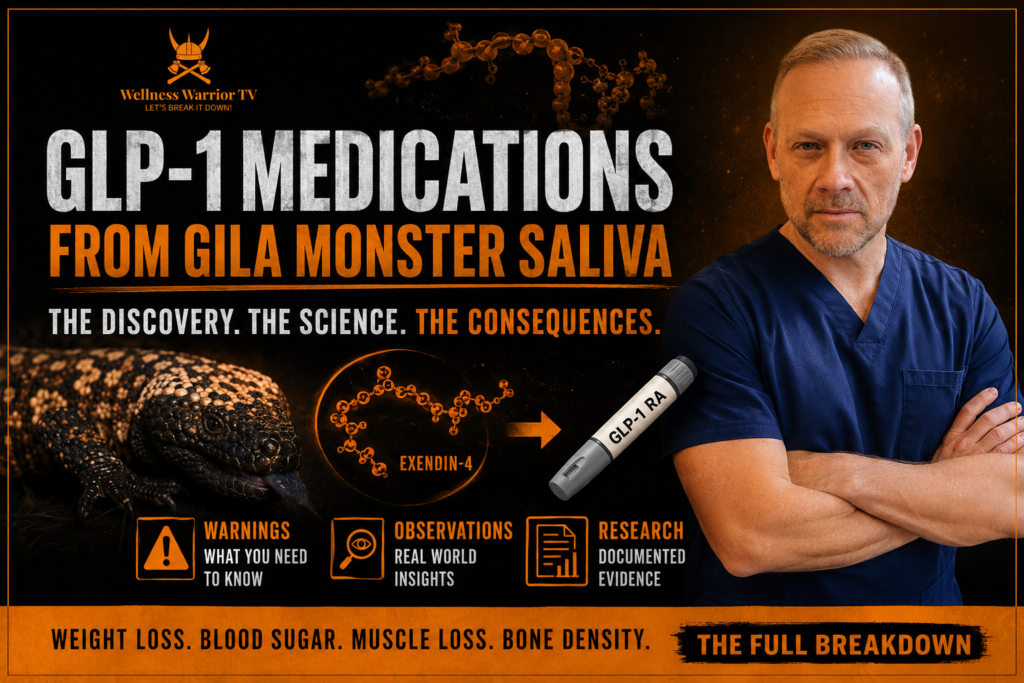
Few medical stories of the past decade have moved as fast as the rise of GLP-1 agonist drugs. Ozempic. Wegovy. Mounjaro. The cultural shift has been remarkable: weight loss has, suddenly, become pharmacological. Buried under the marketing is a simpler story. It’s a tale about a hormone the body has been making on its own for millions of years.
The story should be told plainly. Because once you understand what GLP-1 actually is, the question of whether you need the drug to obtain its effect becomes much more interesting.
The molecular template for every current GLP-1 weight-loss drug was discovered in 1992, in the venom of the Gila monster. A what? Yes, a Gila monster. It’s a slow-moving, desert-dwelling lizard from the American Southwest. Researcher John Eng noticed that the lizard could eat enormous meals only a few times a year and remain metabolically stable in between. He found, in its venom, a peptide he called exendin-4. Upon examination, it was found to be 53% identical to human GLP-1 and to be far more stable in the bloodstream.
That molecule became the chemical template. The drugs you know by brand name today are engineered variants of it.
GLP-1 (glucagon-like peptide-1) is a hormone that the body already makes. It is secreted by the L-cells of the small intestine every time food of the right kind reaches them. It does three things, all useful: it amplifies insulin release exactly when needed, it slows gastric emptying so you feel full longer, and it signals satiety to the brain.
It is not a drug. It is endocrinology, and the body has been doing it, for free, long before the pharmaceutical industry existed.
The trigger for GLP-1 release is contact between the gut and the foods the body evolved alongside: fibrous plants, whole protein, and intact fat in its natural matrix. Ultra-processed food is engineered, intentionally, to slip past the very sensors that would have triggered it. Refined carbohydrate is absorbed so quickly that it never reaches the L-cells in the lower intestine where most GLP-1 is made.
The result: people on the modern diet release a small fraction of the GLP-1 their grandparents did at the same caloric intake. Not because the machinery broke. Because the food stopped triggering it.
Once you see it, the pharmaceutical solution looks different. The drug is real, and it works, but what it does, mechanistically, is supply a signal from outside that the body is fully capable of producing from within, if given the foods that trigger it.
The Cycle of 7 does exactly that. The weekday protein-first structure delivers the single most potent natural stimulus for GLP-1 release. The whole-food emphasis restores the fiber that slows gastric emptying. The fasting windows restore the insulin sensitivity that lets the signal land. If you’re thinking about shelling out hundreds of dollars a month on Monster Venom, give the cycle of 7 a shot. It won’t cost you anything.
For some people, the drug, under medical supervision, is a reasonable tool. For most, the question worth asking is the one the pharmaceutical industry would prefer you didn’t: not ‘how do I get more GLP-1 from outside,’ but ‘why isn’t my body making it anymore?’
The molecule was always there. It was never a deficiency to be supplemented. It was a signal the modern diet stopped sending.
What to Do About It
The first move is unlearning the tray. The full argument, the science, and the structural fix are in Cycle of 7.
Institutional feeding systems must use processed foods to meet budget and scale requirements.
Children absorb a nutrition framework from the tray itself — not from any classroom lesson.
Macro-counting frameworks cannot distinguish a tomato’s carbs from ice cream’s carbs.
Adults unknowingly apply tray logic when evaluating packaged foods as “healthy.”
Optimal health was never the institutional goal — hitting nutrient targets was.