0
Days Tracking
Weight Loss Progress
Starting
--
Current
--
Goal
--
Lost
--
Achievement
Progress Photos
No progress photos yet. Upload some to track your visual progress!
Weight Loss Progress
--
--
--
--
0% towards goal
Achievement
Progress Photos
No progress photos yet. Upload some to track your visual progress!

Let's Break it Down!
Let's Break It Down
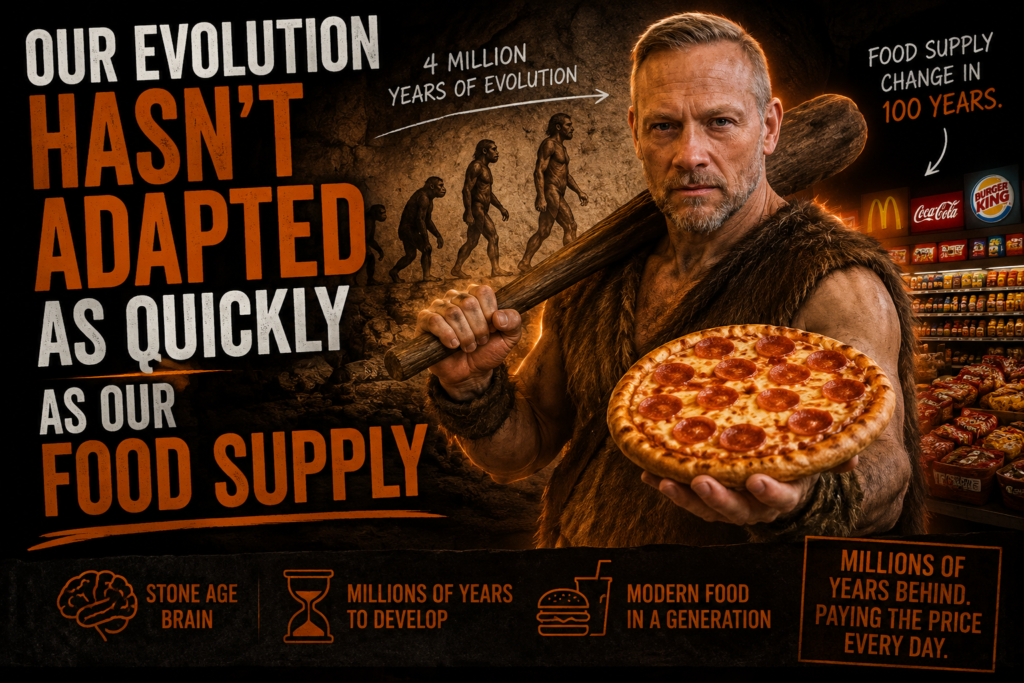
If you were to listen carefully to any conversation about diet and weight loss, it comes down to one accusation: that the person failing to lose weight is failing because of insufficient willpower. Eat less. Move more. Do better. This advice is offered with confidence and received with shame. That sage advice has never helped anyone.
Here is what’s missing: You are not negotiating with a slightly weaker version of yourself. You are negotiating with four million years of evolution.
Your body was engineered with relentless precision. But it was built for a world that no longer exists. Intermittent food, hard physical labor, seasonal abundance followed by lean stretches, and the constant possibility of starvation. Every system in you evolved to survive that world. That’s what the body does best. It survives.
The key to survival was the ability to efficiently store body fat. Once stored, that body fat was defended as if your life depended on it, because it did. When food was scarce, the body would slowly and reluctantly release fat, and only when the body was genuinely confident that famine wasn’t looming would fat be burned outside of starvation mode. These are not metabolic flaws. They’re features so successful that the genes that code them have outlived every alternative.
Most popular diet advice asks the body to ignore these features. Eat less, the advice says, and the body will give up its reserves. The body, having spent four million years preparing for exactly this scenario, does not relent. It defends. It lowers metabolic rate, increases hunger, slows thyroid output, and prepares to fight for your life. The process is so reliable that researchers in the 1940s documented its effects in healthy young men under a controlled, semi-starvation scenario. Those findings remain undisputed.
It’s not metaphorical. This is the literal, measurable, repeatable physiology of caloric restriction. The body is doing exactly what it was built to do. Calling that ‘failure’ is calling water wet.
The body is not the enemy. It never was. The environment is. The food environment is what changed in the last hundred years, not the body. The shape of the modern diet — constant eating, processed substrate, engineered palatability, refined carbohydrate at every signal — is the new variable. The four-million-year body is the constant.
Stop fighting the constant. Change the variable.
Your body is not broken. It is ancient, precise machinery operating in an environment it was never built for. The fight is not against the body — that fight cannot be won, and was never the right one. The fight is against the environment.
Everything in the Cycle of 7 is built on this principle. It does not ask you to overpower your biology by will. It changes the conditions your biology is responding to, so that the same machinery that defended the old weight does the work of releasing it. You stop fighting. The body, given a different question to answer, answers differently.
What to Do About It
The first move is unlearning the tray. The full argument, the science, and the structural fix are in Cycle of 7.
Institutional feeding systems must use processed foods to meet budget and scale requirements.
Children absorb a nutrition framework from the tray itself — not from any classroom lesson.
Macro-counting frameworks cannot distinguish a tomato’s carbs from ice cream’s carbs.
Adults unknowingly apply tray logic when evaluating packaged foods as “healthy.”
Optimal health was never the institutional goal — hitting nutrient targets was.